
2022
/ Community Development
BSP
Bosques of San Pedro is a neighborhood located on the outskirts of Juárez, of which we proposed to intervene the existing context, creating new opportunities for activities that improve the quality of life in the community, enabling its old state.
After making an investigation in a macro and micro scale, as well as emphasizing the peculiarities of this neighborhood, we achieved an adequate design as well as belonging, with the main objective of creating a unique community like the one of Bosques de San Pedro.
/ Awards
2022 1st place Catedra Infonavit 9.0
2022 Conference Speech ITESM Housing: Thoughts from the Academy
2022 Publication Habitar en Hilera: Experimental Laboratory of Architecture
/ Location
Juarez, Mexico
/ Collaborators
David Márquez
Martina Aguilar
Paulina Padilla
Ana Karen Ruelas
"The identity of a community"
This project was an extensive intervention of the neighborhood Bosques de San Pedro, from the urban scale to the housing scale. By saying this, it's divided into four sections to make it easier to navigate. Click the option you´re interested in.

/ Local Analysis
Site Research & Conclusions

/ Urban Proposal
Infrastructure & Centers

/ Housing Proposal
Rehabilitation & Creation

/ Self - Production Manual
Physical & Digital
Local Analysis
Main problematic

Incomplete 22%
Abandoned 6.5%
Commerce 3.5%
The main problem of the housing in the neighborhood is that 40% of the incomplete houses are abandoned, but the rest are inhabited.
Through a demographic speculation, we notice a paradox in which housing is increasing, however, the inhabitants are decreasing.
To understand better, we made observations on the main street and we were able to notice several reasons for this. We noticed that it is a neighborhood full of families, active and diverse, however, its insecurity and robberies prevent the houses from continuing their construction adequately.
Other important factors would be the water damage that occurs in the streets and sidewalks, due to the runoff of rainwater from Cerro de la Silla, since it is located on the outskirts of Juárez.


Street Animals
Insecurity
Active Neighborhood
Water Damage
Abandonment
Social Interaction
Public Transp.
Vandalism
Families
Garbage on streets
Houses in bad condition
Vegetation
Active Constr.
Local Commerce
Colorful Facades
Unpaved Streets

Urban Proposal
Water usage drainage

The neighborhood is located right next to Cerro de la Silla, which is why a rainwater harvesting system is proposed to prevent the accumulation and puddle of water, which also increases the quality of roads in the neighborhood for better public circulation.
This proposal takes advantage of the natural flow of water, guiding the runoff down slope, capturing in different green interceptors and redirecting it underground. These capturing spots also function as meeting points/pocket parks for the community around the neighbourhood.


Source
Water runoff from the Cerro de la Silla.
Built Limit
Water capture barrier
Capturing Spot A
Meeting Point
Capturing Spot B
Meeting Point
Capturing Spot C
Meeting Point
Pluvial Natural Flow
Undergoing rerouting
Height
System

/ Typologies of urban connections
01 / Active connection between the road and the sidewalk.

02 / Dialogue between public transport and connection centers.

03 / Use of abandoned lots as connections between streets and neigbhors.
Urban Proposal
Connection Centers

We proposed a diversity of centers for a diversity of people in which they all include mixed uses to extend their stay and reduce insecurity by increasing the number of activities within the neighborhood.
This connection spaces engage an existing design pattern found in the neighborhood, to create order, unity and belonging. These design elements were light structure, symbolism, multipurpose and resignification of local materiality.
For its construction, four self-produced actors are involved, creating an active and participating community.

Locals
User
Constructor
Architect
Self-produced actors

Attention Center

/ Connection Spaces

Hyperlocal Center


DIF Center
Health Center


Cult Center
Security Center


Commerce Center


Playground Center
Transport Center


Instead of proposing a
sustainable home, wouldn’t it be more honest to recycle?
In response to the context, our housing proposal is based on monitoring and replicating these peculiarities; all of this aimed at fostering a sense of belonging and personalization, emphasizing its existing character.
Four families of the neighborhood were interviewed in order to find relevant data on their lifestyle and quality of housing, which were obtained.
Afterwards, an adapted version of the book Tools to inhabit the present was implemented into our project, were we evaluated each selected residence, as well as a diagram of housing growth that we obtained during the interview of each individual.
/ Design Strategies
01 Mixed Uses
02 Accumulation of material
03 Street Appropiation
04 Roof Occupancy
05 Personalization
06 Transitional Space
07 Delimiting Structure
08 Vegetation on the facade

/ Strategy
Mixed Uses
Signage
House
Shared access
Local store
Function: house + store
Location: St. Nogales

/ Strategy
Accumulation of material
Function: house
Location: St. Huizache
Accumulation of boxes
House
Accumulation of boxes
Access
Cart
Transitional space

/ Strategy
Street Appropiation
Function: house
Location: St. Encinos
Independent access
House
Closed access
Social Exterior Space
Access

/ Strategy
Personalization
Function: house
Location: St. Fresnos
House
Patio
Access
Added details in facade
Garage
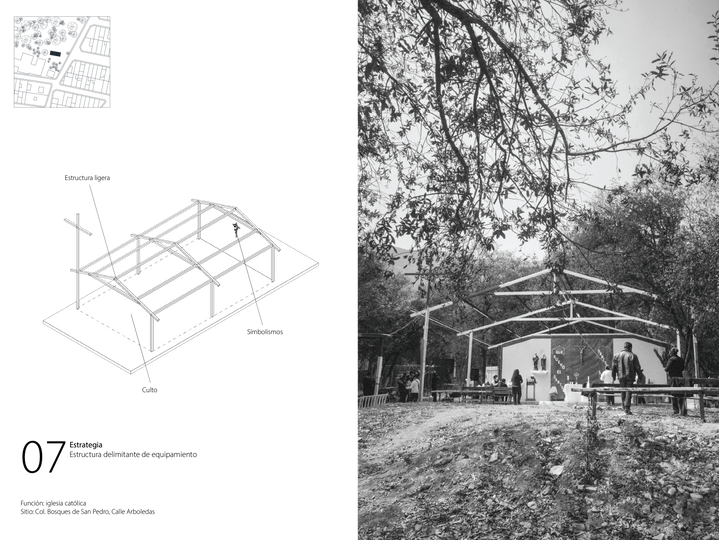
/ Strategy
Delimiting Structure
Function: cult
Location: St. Arboledas
Siimbolism
Cult
Light Structure

/ Strategy
Roof Occupancy
Function: house
Location: St. Fresnos
House
Access
Swings
Roof

/ Strategy
Transitional Space
Function: house
Location: St. Duraznos
House
Balcony
Access
Garage
Transitional space

/ Strategy
Vegetation in facade
Function: house
Location: St. Fresnos
House
Vegetation
Vegetation
Protection in windows
Housing Proposal
Rehabilitation

/ Before

Maria Ines Fernandez
Age
70 years
Ocupation
Doesn't work
Time living in BSP
40 years
People that live with her
(0) She lives alone

/ After

Self-produced Actors
Tools to inhabit the present analysis
Tools to inhabit the present analysis

Constructor

Locals
Stages of Self-Production
Stage 01
01 Fence
02 Entrywway
03 Interior Remodeling
Stage 02
Adapt for rent in:
04 Second Level
05 Lateral Space
Stage 03
06 Local Commerce

Main problem
The house has abandonment problems in its design that make it impossible to use the house properly. It is incomplete and consists of 4 unused rooms, due to the fact that there is only one elderly user who was looking for a more efficient home.


Solution
After the intervention, a house is obtained that satisfies the needs of the user through three stages that were: 1. enable housing 2. profitable space 3. productive space and solved by present actors, as well as the incorporation of the mentioned peculiarities transformed to design strategies.
Housing Proposal
Creation
New user

Tools to inhabit the present analysis
For the empty lots in the neighborhood, a progressive dwelling was proposed, which is totally adaptable to the needs of the user. This is due to a service core that has what is necessary, so that its expansion would be flexible and different for each person, creating in itself the community of Bosques de San Pedro.

Stage 0
Sizing
Stage 1
Service Space
Stage 2
Private & Public Space
Stage 3
Multipurpose Expansion
Stage 4
Independent Expansion

Stages of Self-Production
Stage 00
Basic Needs
Stage 01
Extension of Mixed Uses
Stage 02
Extension for Passive Income
Stage 03
Extension for Local Commerce
/ Design Strategies
01 Mixed Uses
02 Accumulation of material
03 Street Appropiation
04 Roof Occupancy
05 Personalization
06 Transitional Space
07 Delimiting Structure
08 Vegetation on the facade

Locals
Architect
Self-produced actors
Constructor
User
07

04
02
06
08
01
03
05
Self-Production Manual
Digital & Physical
To complete the intervention of the neighborhood, we thought it was important to create a tool for the residents to understand how responsible self-production works and how they can use it for their advantage in a realistic way.
We decided to develop a manual, available in both digital and print formats, to help residents create a distinctive neighborhood that focuses not only on appropriate design but also on a sense of belonging, creating a unique community like Bosques de San Pedro itself.


Step 01
Download the app
Step 02
Answer according to the chosen dweling
Step 03
Receive score from
the evaluation of Tools to Inhabit the Present
Step 04
Receive suitable design suggestions
Step 05
Receive information about the Infonavit credit to create the house


